

Level up your winter energy game plan
Looking for ways to save on energy use? Our winter guide has you covered.

How cold weather affects your energy use

How the weather and demand affect your bill

Manage your energy use and bill

Tips to reduce energy use
How the cold weather affects your usage
Cold weather plays a major role in increasing your energy use, which can have a big impact on your bill. Understand how:
During colder months, your heating system has to work harder and run longer to maintain the indoor temperature. It’s important to understand what’s a comfortable temperature for you and your family.
Cold weather means colder water entering your water heater, which requires more energy to heat it. That’s why the shower takes longer to get to that sweet spot.
Spending more (cozy!) time at home can lead to higher energy use for heating, lighting, and appliances. We also love to watch TV on a Sunday with a blanket and some hot cocoa!
Older or less efficient heating systems, as well as poor insulation or drafts around windows and doors, can cause your heating system to work harder. You can check out our Insulation & Air Sealing Rebates pages to help you make your home more energy efficient.
Using space heaters can add significantly to your energy bill. A typical 1,500-watt space heater used for 8 hours a day can add around 360 kilowatt-hours (kWh) to your monthly bill. We were amazed as well!
How the weather and demand affect your bill
Your energy use affects both your supply and delivery charges because your usage is combined with the rates to determine your total costs. While your delivery rate stays the same for longer periods and is set by the PSC, your supply rate varies regularly depending on market demand.
Supply prices have risen over the past year due to increasing consumption of electricity and natural gas. With the colder-than-normal weather we’re experiencing this winter, demand is climbing even higher and pushing supply prices up.
If we purchase energy on your behalf (always with no markups!), you may have noticed that supply rates have increased. For example, on January 30, 2026, electricity supply rates were 36% higher than on the same day last year. This means that even if your electricity or natural gas use stayed the same, your total charge is likely higher this year. Here are a few examples:
- A standard residential customer using 716 kWh of electricity in February would see about a $22 increase (39%) in supply costs compared to last year.
- A natural gas customer using 182 therms in February would see an increase in supply costs of approximately $52 (72%) compared to last year.
- A time-of-use rate customer using 501 kWh during daytime hours and 215 kWh during nighttime hours between January 10 and February 9 would see a $61 increase (74%) in daytime supply costs and $21 more (87%) for nighttime supply compared to last year.
You can compare supply rate costs by viewing your billing history, whether we purchased on your behalf or another energy service company (ESCO) does it for you, or by using our Supply Price Tool, if we purchase on your behalf.

We take measures to mitigate the impact of market fluctuations by forecasting and purchasing energy supplies to help smooth fluctuations in supply prices for Standard Service (SC1) electricity customers. Customers on Time-of-Use (SC4) rates experience supply-cost changes more immediately.

If you need financial assistance, visit our Help With Bill page, where you’ll find a variety of support programs.

To learn more, explore our sample bill, visit our pricing page or watch this short video from the New York Independent Operator (NYISO).
Manage your energy usage and bill
We help you to keep track of your usage and manage your energy bill.

Alerts
Sign up for alerts to track you energy use, set up targets and get notified of big usage shifts. Stay informed during outages and winter storms.

Budget Billing
Enroll in Budget Billing to balance your energy costs throughout the year and avoid surprises during the heating season.
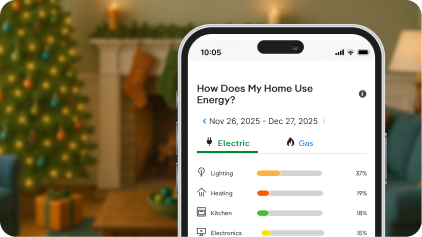
Energy Manager
With Energy Manager, you can: track your energy use down to the hour, see how your use compares to similar homes and get personalized tips to reduce your energy consumption.
Tips to reduce energy use
A few simple tweaks can make a big difference in your usage
Lower your thermostat 7°–10°F for 8 hours a day to save up to 10% a year on heating and cooling. In winter, keep it around 68°F when awake and lower when asleep or away.
Look for and seal any leaks in your duct work. A simple roll of duct tape from your local hardware store can do the trick!
Make sure to replace or clean your furnace filters when they get dirty or at least once a month to keep your system running efficiently.
Roll up a small rug or towel and place it across the bottom of your door to prevent cold air from sneaking in.
Close heat registers in rooms you’re not using, but ensure the temperature stays above freezing to protect your pipes.
Consider installing a programmable or Wi-Fi thermostat to automatically control your heating and save money by lowering the temperature when you’re not home (unless you have a heat pump). Control the temperature at anytime, anywhere!
Switching to a heat pump can cut electricity use by up to 75%. Learn more about heat pumps and enjoy our rebates with our NYS Clean Heat Rebate page.
Switch to high-efficiency LED lighting. LEDs use 90% less energy than standard incandescent bulbs and last up to 25 times longer.
Turn off lights whenever you leave a room or don’t need them. Empty rooms don't need the lights on!
Always load the dishwasher to its full capacity. Choose the most energy-efficient drying option—heat dry is usually the least economical. For extra savings, skip the drying cycle and let dishes dry naturally. Turn off the drying cycle, open the dishwasher, and let the contents dry naturally.
According to the DOE, set your refrigerator to 38-40°F and your freezer to around 5°F. Remember, every time you open the fridge, cold air escapes!
Use the oven window to check on your food instead of opening the door and letting heat escape. Remember: patience is a virtue!
Use advanced power strips to eliminate ‘standby’ power that many devices consume even when turned off.
Set your water heater to 120°F. Many are preset at 140°F, which usually uses more energy than necessary.
Stress-free season
Whether you're hitting the slopes or staying in by the fire, our digital tools have you covered.

eBill
With our paperless eBill service, your energy bill arrives safely in your inbox — no snow boots required. Login now and go to ‘Preferences’.

AutoPay
AutoPay takes care of your bill automatically, so you can focus on what really matters - spending time with your loved ones. Login now and go to ‘Preferences’.
Mobile App
Check your bill, make payments and report outages — anytime, anywhere, even from the ski lodge.